Do I Need a Website If I Have Social Media? Here's What Irish Business Owners Should Know
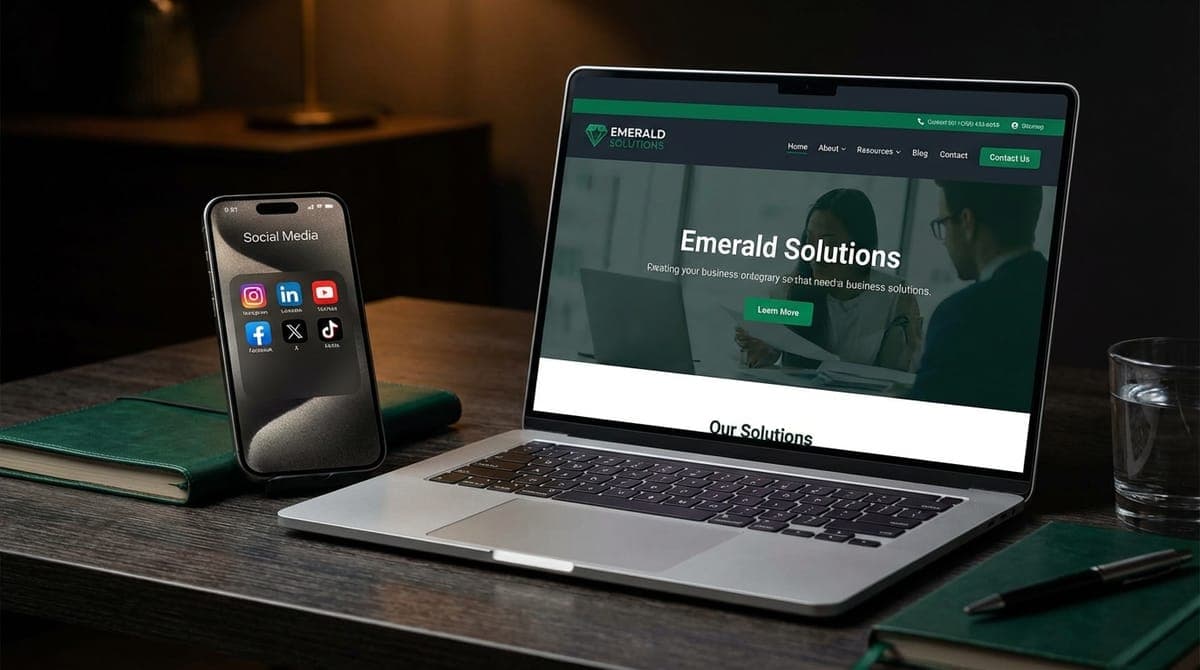
It's a Fair Question, But It's the Wrong Either/Or
If you're running a small business in Ireland or the UK, chances are you've got a Facebook page, maybe an Instagram account, and you're wondering whether you really need to spend money on a website as well. It's a completely fair question.
Social media is powerful. It's free to set up, billions of people use it every day, and it gives you a direct line to your customers. I'm not going to sit here and tell you it doesn't matter; it absolutely does.
But there's a meaningful gap between what social media can do for your business and what a website can do. They're different tools that serve different purposes, and the smartest approach is using both. Let me explain why.
What Social Media Does Well
Credit where it's due: social media is brilliant at certain things.
It's where your existing customers hang out. When you post a photo of a finished job, share a seasonal offer, or reply to a comment, you're building a relationship with people who already know about you. That kind of community building and day-to-day visibility is incredibly valuable.
Social media is also fast. You can post an update in thirty seconds. Share a behind-the-scenes video. Respond to a message in real time. There's an immediacy to it that a website simply doesn't have.
For staying top of mind with your current audience, social media is hard to beat. But here's the thing: there are some crucial jobs it simply cannot do for your business.
What a Website Gives You That Social Media Can't
Google Discoverability
This is the big one. When someone needs a service, what do they do? They open Google and type something like "plumber near me" or "website designer Ireland." They're not searching Instagram. They're not scrolling Facebook.
Google search results show websites, Google Business Profiles, and map results. Your Instagram page isn't going to appear when someone searches "electrician in Cork" or "handyman Brentwood." A properly optimised website will.
This matters because there's a fundamental difference between social media followers and Google searchers. Your followers already know you exist. Google searchers are actively looking for someone who does what you do, right now, in their area. These are the highest-intent potential customers you can reach, and without a website, you're invisible to them.
I've written a detailed guide on how local SEO works if you want to dig deeper: Local SEO for Small Businesses in Ireland covers everything from Google Business Profile optimisation to the content that helps you rank.
Credibility and Professionalism
Like it or not, customers judge businesses by their online presence. When someone hears about you through word of mouth, the first thing they do is Google your name. If all they find is a Facebook page with a few posts from last month, some will hesitate. It doesn't feel established.
A clean, professional website signals that you're serious about your business. It tells potential customers that you've invested in how you present yourself, that you're not going anywhere, and that you care about making a good impression.
This is especially true for trades, professional services, and anything where customers are spending real money or inviting you into their home. The credibility gap between "has a website" and "Facebook only" is bigger than most people realise.
I've seen it firsthand with my own clients. After launching their website, they noticed more enquiries, not just from Google search, but from word-of-mouth referrals too. The website gave those referrals the confidence to follow through. I cover more of the reasoning in Why Every Local Business Still Needs a Website in 2026.
You Control the Experience
On social media, you're a guest on someone else's platform. Your Facebook page looks like every other Facebook page. Your posts compete with ads, memes, and your customer's cousin's holiday photos. The algorithm decides who sees what, and you have no say in it.
On your website, you control everything. The layout, the colours, the messaging, the order in which visitors see information. You can guide someone from "what does this business do?" to "I should get in touch" in a logical, deliberate way. No competing distractions.
And here's a sobering statistic: organic reach on Facebook business pages sits around 2-5% of your followers. If you've got 500 followers, maybe 10-25 of them see your post on a good day. That's not a platform you can rely on as your primary online presence. It's a complement to one, but it shouldn't be the foundation.
The Real Answer: They Work Together
The question shouldn't be "website OR social media?". It should be "how do I use them together?"
Here's how the funnel actually works in practice. Let's say you're a tradesperson. You finish a job and post a photo on Instagram showing the completed work. A follower sees it and shares it with a friend who's been looking for that exact service. The friend taps on your profile, clicks the link in your bio, and lands on your website.
On your website, they see your full list of services, read a bit about how you work, check your service area, and fill out the contact form. Job done. That customer journey, from social media awareness to website conversion, is how the two channels complement each other perfectly.
Social media is your megaphone. It builds awareness, keeps you visible, and drives traffic. Your website is your shopfront. It's where people go to learn more, build trust, and take action.
And don't forget Google Business Profile, the third piece of the puzzle. It links to both your website and your social media, ties everything together with reviews and location data, and puts you on Google Maps. All three channels working together give you the strongest possible local presence.
But I'm Getting Customers Through Social Media Already
If social media is already bringing in work, that's great, genuinely. But consider two things.
First, you're only reaching people who already know about you or who happen to see a shared post. You're missing the much larger pool of people actively searching Google for your services. Those are the easiest customers to convert because they're already looking for exactly what you offer.
Second, you're entirely dependent on platforms you don't control. Facebook's algorithm changes regularly. Instagram's reach for business accounts has been declining for years. TikTok's future in certain markets is uncertain. If any of these platforms change their rules, reduce your reach further, or restrict your account, your entire customer pipeline takes a hit.
A website is your insurance policy. It works 24/7, it belongs to you, and Google sends you traffic based on the quality of your content, not on an ad budget or an algorithm's mood.
Frequently Asked Questions
Can I just use a Facebook page instead of a website?
Will a website help me show up on Google?
How much does a basic business website cost?
Do I need to post on social media if I have a website?
Ready to Give Your Business a Proper Home Online?
If you've been relying solely on social media and you're wondering whether a website would make a difference: in my experience, it almost always does. Not because social media isn't working, but because a website opens up an entirely new channel of customers who are actively searching for what you offer.
I build clean, fast websites for small businesses in Ireland and the UK, and I handle the hosting and maintenance so you don't have to think about it. If you'd like to chat about what a site would look like for your business, get in touch. No pressure, no hard sell, just a conversation about whether it makes sense for you.
Related Articles
What Does It Cost to Run a Website in Ireland? Monthly and Annual Fees Explained (2026)
Hosting, maintenance, SSL, domain renewal, and support retainers: here's the full ongoing cost of running a business website in Ireland, with real Irish market prices for 2026.
How to Choose a Web Developer in Ireland: The Complete Guide for Small Businesses (2026)
A transparent, practical guide to finding and vetting a web developer in Ireland. Covers what to look for, red flags, pricing models, questions to ask, and how to avoid costly mistakes.
SEO and GEO: How AI Search Is Changing the Game for Small Businesses in Ireland (2026)
AI search engines like Google AI Overviews, ChatGPT, and Perplexity are changing how customers find local businesses. Here's what SEO and GEO mean for small businesses in Ireland and the UK, and what you can do about it.