Wix vs Squarespace vs a Custom Website: Which Is Right for Your Irish Small Business? (2026)
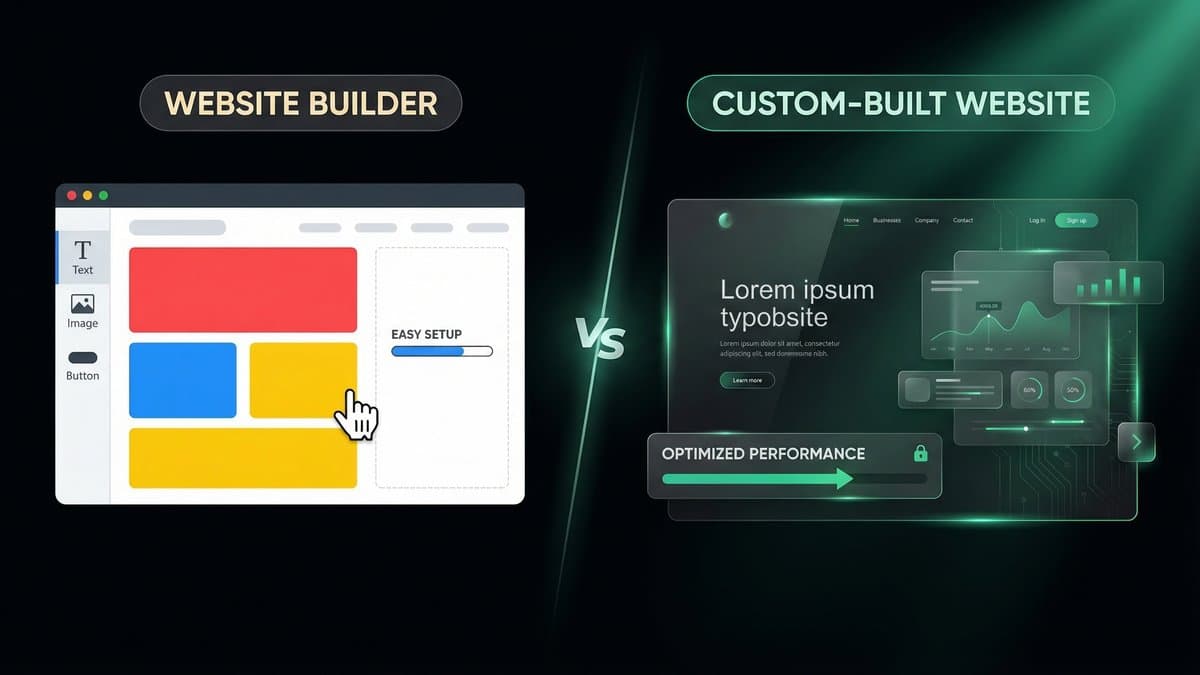
The honest answer is: it depends.
I know that's not what most people want to hear, but it's the truth, and I'd rather give you a straight answer than steer you toward the option that benefits me most. The reality is that Wix and Squarespace are genuinely good for some businesses, and recommending a custom website to someone who doesn't need one is a waste of their money.
What I want to do in this article is give you an honest comparison of all three options (real costs, real SEO trade-offs, real use cases) so you can make the right choice for your situation. I've built websites for small businesses in Ireland and the UK, and I've seen what works and what doesn't.
Let's start with the numbers, then get into the detail.
Quick Comparison: Wix vs Squarespace vs Custom Website
| Wix | Squarespace | Custom | |
|---|---|---|---|
| Setup cost | €0–€500 | €0–€500 | €500–€1,200+ |
| Monthly cost (2026) | €17–€35/mo | €16–€40/mo | €10–€25/mo (hosting only) |
| You own the site | No | No | Yes |
| SEO capability | Basic | Basic | Full |
| Design flexibility | Moderate | Moderate | Unlimited |
| Page speed (avg CWV score) | 50–65 | 55–70 | 85–98 (if built well) |
| Custom schema markup | No | No | Yes |
| Can add custom features | Very limited | Limited | Yes |
| Platform lock-in | High | High | None |
A lot of that table is self-explanatory, but the details behind it matter, especially the SEO row. I'll get to that.
Wix: What It Is and Who It's Actually For
Wix is a drag-and-drop website builder that lets you create a site without writing any code. You pick a template, drag elements around, fill in your content, and publish. It's genuinely easy to use, and for certain situations it's a reasonable choice.
What Wix Does Well
- Speed to launch. You can have a basic site live within a day or two.
- No technical knowledge required. You don't need a developer, and the learning curve is shallow.
- App marketplace. Wix has hundreds of add-ons (booking tools, live chat, email marketing), though most are third-party and add to your monthly cost.
- Free tier available. You can build and publish for free, though the free plan includes Wix branding and limited features.
Where Wix Falls Short
Platform lock-in is the big one. Your Wix website lives on Wix's servers and is built in their proprietary system. You cannot export your website and host it elsewhere. If Wix raises its prices, changes its policies, or shuts down a feature you rely on, you have no exit option except rebuilding from scratch.
Page speed is genuinely a problem. Wix generates a lot of JavaScript to power its drag-and-drop functionality. That code runs in the browser and slows down your pages. In my testing and in third-party benchmarks, Wix sites consistently score between 50–65 on Google PageSpeed Insights for mobile. A score below 70 puts you at a disadvantage in Google rankings.
Limited structural control. You can move elements around on a template, but you cannot control the underlying HTML structure, URL format at a deep level, or how certain elements are rendered. For basic brochure sites this doesn't matter much. For SEO-focused builds, it becomes a real constraint.
No custom schema markup. Schema markup (structured data in JSON-LD format) is how you tell Google exactly what your business is, what services you offer, your opening hours, your location, and more. It's critical for local SEO and for appearing in AI-generated search summaries. Wix has no support for custom JSON-LD schema injection. That's a meaningful gap.
Who Wix Is Right For
- Micro-businesses and sole traders testing an idea before committing to a proper online presence
- Hobby sites or personal projects with no SEO ambitions
- Very early-stage startups that need something live this week and have zero budget
- Businesses where the owner has time to manage the site and doesn't need integrations
Squarespace: What It Is and Who It's Actually For
Squarespace is a step up from Wix in terms of design quality and code cleanliness. It produces aesthetically polished websites and has built a strong reputation among creative professionals.
What Squarespace Does Well
- Beautiful templates. Squarespace templates are genuinely well-designed, and the end results look professional with relatively little effort.
- Cleaner code than Wix. Squarespace generates leaner HTML, which contributes to marginally better page speed scores than Wix.
- Good for visual content. Photographers, designers, and creative businesses find Squarespace's gallery and portfolio tools genuinely useful.
- Slightly better mobile performance. Squarespace sites typically score 55–70 on PageSpeed mobile, a bit better than Wix.
Where Squarespace Falls Short
The same fundamental problems as Wix apply:
Platform lock-in. Your site is on Squarespace's infrastructure. You can export some content (blog posts, basic pages) but not the site itself. Moving off Squarespace means rebuilding.
Less flexible than custom. Squarespace gives you less design freedom than Wix in some ways (it's more opinionated about layout), but more polished results within those constraints. Either way, you're working within their system.
Limited plugin ecosystem. Unlike WordPress, Squarespace doesn't have a rich third-party developer community. The integrations available are more limited, and complex functionality often isn't possible.
Still no custom schema markup. Like Wix, Squarespace doesn't support injecting custom JSON-LD structured data in a reliable, controlled way. Some workarounds exist, but they're fragile and platform-dependent.
Not ideal for service businesses needing forms or flows. If you need conditional logic in forms ("if the customer selects X, show field Y"), or a multi-step quote request process, or integration with your CRM or booking system, Squarespace quickly reaches its limits.
Who Squarespace Is Right For
- Photographers, designers, illustrators, and other creative professionals who need a visually impressive portfolio
- Product-based small businesses with simple inventory needs
- Businesses where the brand aesthetic is the primary product
- Owners who are comfortable maintaining the site themselves and don't need complex integrations
Custom-Built Website: What It Is and Who It's Actually For
A "custom website" means a site built by a developer using a proper technology stack. In my case that's Next.js with Tailwind CSS, though WordPress is also common. The key difference is that you own everything: the code, the content, the hosting setup.
What a Custom Website Does Well
You own the asset outright. The code is yours. You can host it anywhere, move it to a different developer, or hand it to someone else to maintain. There's no platform dependency, no monthly fee to a US company, and no risk of a pricing change making your site unaffordable.
Full SEO control. Every element that affects SEO (page titles, meta descriptions, heading structure, URL format, image compression, schema markup, Core Web Vitals performance) is fully in your hands. There's no platform imposing constraints.
Page speed can be genuinely excellent. A well-built custom website on modern infrastructure regularly scores 85–98 on Google PageSpeed. That's a meaningful advantage over Wix and Squarespace in Google rankings, particularly for competitive local search.
Schema markup done properly. I build LocalBusiness JSON-LD schema into every local business website I create. This tells Google exactly what the business is, where it operates, what its hours are, and what services it provides. It's one of the most important (and underused) local SEO tools available.
Can integrate anything. Booking systems, CRM tools, AI chatbots, custom contact forms with conditional logic, quote calculators, payment gateways: if a third-party API exists, it can be integrated. You're not limited to a curated app marketplace.
Unlimited design flexibility. The site looks the way your business needs it to look, not the way a template was designed for someone else's business.
Where Custom Falls Short
Higher upfront cost. You're paying for developer time, and that costs more than a Wix subscription. A custom website from me starts at €500 for a simple site. More complex builds with booking systems or integrations cost more.
You need a developer for structural changes. If you want to add a new section type, change the site architecture, or build a new feature, you need to come back to me (or another developer). Minor content updates (text, images, blog posts) can be handled without technical help.
More planning required upfront. A good custom website starts with a proper brief. What do you need it to do? Who is it for? What's the goal? That planning process produces a better result, but it requires a bit more of your time upfront.
Who Needs a Custom Website
Five clear signals that a custom build is the right choice:
-
You're serious about ranking locally on Google. If local search traffic matters to your business (and for most service businesses in Ireland and the UK, it's the primary channel), you need full SEO control.
-
You need a contact form with real logic, a booking system, or a quote calculator. Basic forms are possible on Wix and Squarespace. Anything beyond basic isn't.
-
You want to integrate third-party tools. CRM, email marketing, live chat, AI chatbot, payment processing: these integrations work cleanly in a custom build.
-
You're tired of looking like everyone else. If your competitors are all on the same Wix templates and you want to stand out, custom is the only way to achieve genuine design differentiation.
-
You want to own your website, not rent it. If you're investing in a digital asset for your business, it makes sense to actually own it.
Real Cost Comparison: 3-Year View
This is the calculation that surprises most people. Let's look at what you actually spend over three years:
Wix Business Plan (2026): €0 setup + €25/month × 36 = €900 over 3 years, but at the end of those 3 years, you own nothing. You still can't move the site.
Squarespace Business Plan (2026): €0 setup + €30/month × 36 = €1,080 over 3 years, with the same problem. The site is Squarespace's.
Custom website (my pricing): €800 setup + €15/month hosting × 36 = €1,340 over 3 years, and you own the asset outright, have full SEO control, no platform lock-in, and can extend it whenever you need to.
The gap is smaller than most people expect. And the custom option comes with compounding advantages: better SEO performance from day one means more enquiries over time, the site grows with your business, and there's no risk of a platform pricing change making it unaffordable.
For more context on website pricing, my article on how much a website costs in Ireland covers this in more detail.
SEO: The Biggest Hidden Difference
This is the part most people don't think about when choosing a website platform, and it's where the gap between builder platforms and custom is most significant.
Page Speed and Core Web Vitals
Google uses Core Web Vitals (measures of loading speed, interactivity, and visual stability) as a ranking factor. Slow pages rank lower. This is especially true on mobile, where most local searches happen.
In 2026 benchmarking, Wix sites average 50–65 on Google PageSpeed mobile. Squarespace sits at 55–70. A well-built custom site on quality hosting routinely scores 85–98.
That's not a small gap. A site scoring 55 and one scoring 92 aren't competing on equal footing in Google's ranking system.
Schema Markup: Critical for Local SEO and AI Search
Custom JSON-LD schema is how you provide Google with machine-readable structured data about your business. For a local business, this includes:
- Your precise business name, address, and phone number
- Your service area (which towns/areas you cover)
- Your opening hours
- Links to your social profiles
- Your Google Business Profile URL
This schema feeds directly into Google's local knowledge graph and (increasingly important in 2026) into AI-generated search summaries. When Google's AI Overview answers a local search query, it draws on structured data to identify and cite specific businesses.
Wix and Squarespace don't support custom JSON-LD schema injection in a controlled, reliable way. Custom builds do it properly from the start.
URL Structure and Site Architecture
Custom builds give you full control over your URL structure. /services/emergency-plumbing rather than /page-12345. Proper URL structure contributes to SEO and makes the site more navigable.
When a Website Builder Is the Right Call
I want to be honest about this, because there are situations where Wix or Squarespace genuinely is the better choice:
- You need something live this week and have no budget for a developer
- You're testing a business idea before committing to a full build
- Your site is purely informational: just a digital brochure with no booking or enquiry flow
- You're a creative professional who needs a polished portfolio and Squarespace's templates suit your aesthetic perfectly
- You're comfortable maintaining it yourself and don't plan to compete seriously in local search
If any of those describe your situation, Wix or Squarespace may be the right call, and I'd tell you that to your face.
Case Study: handymanbrentwood.uk
Let me give you a concrete example of what a custom build does that a website builder can't.
I built handymanbrentwood.uk for a London-based handyman who needed more than a brochure site. The brief was: get found locally, look professional, and make it easy for potential customers to contact him.
What went into the build:
- Fast load times: built on Next.js with Tailwind CSS, the site scores consistently above 90 on Google PageSpeed on both mobile and desktop
- LocalBusiness schema markup: structured data that tells Google exactly what services are offered, where, and how to reach the business
- Mobile-first design: optimised for the phone screens where most local searches originate
- Proper URL structure and on-page SEO: targeting specific local search terms from the ground up
Currently in final testing before launch: an AI chatbot integration that takes this further than any website builder could. Here's what it does:
- Greets visitors and answers common questions about services and pricing in real time
- Lets customers request a callback slot directly within the chat conversation
- Automatically sends the handyman a pre-call brief: the customer's name, location, job description, and any relevant details captured in the chat
The result is that before he even dials, he knows the job scope. No wasted calls, no time spent gathering basic information over the phone. The enquiry arrives pre-qualified.
None of this is possible on Wix or Squarespace without cobbling together three or four separate paid third-party apps, each with its own monthly fee, its own login, and its own failure point. In a custom build, it's one integrated system.
For more on what AI chatbots can do for local service businesses, my article on AI chatbots for small businesses goes into detail.
Frequently Asked Questions
Is Wix good for SEO in Ireland?
Wix has improved its SEO capabilities significantly over the past few years and is no longer the SEO disaster it once was. For basic local businesses with low competition, it can work adequately. However, the core limitations remain: slow page speed on mobile (averaging 50–65 on PageSpeed), no custom schema markup support, and limited control over technical SEO elements. For competitive local search terms in Ireland and the UK, these are real disadvantages.
Can I switch from Wix to a custom website later?
Yes, but it means starting from scratch. Wix doesn't allow you to export your website in a portable format. You can export blog post content and some data, but the website itself (the design, structure, and code) stays on Wix's platform. If you move to a custom site, it will be a new build. That's worth factoring in when you're making the initial decision: if you think you'll want to move eventually, starting custom may be more cost-effective long-term.
Is Squarespace better than Wix for small businesses?
They're suited to different things. Squarespace produces more visually polished results and has marginally better page speed. It's particularly well-suited to creative businesses, photographers, and product-based brands. Wix has a larger app marketplace and slightly more flexibility in layout. For service businesses in Ireland and the UK focused on local SEO, neither has a meaningful advantage over the other; the fundamental limitations are similar.
How much does a custom website cost compared to Wix?
Over a 3-year period, the cost difference is smaller than most people expect. A basic Wix plan costs around €900 over three years (ongoing monthly fees, nothing owned). A custom website from me is approximately €1,340 over three years (€800 setup + €15/month hosting), and you own the asset, there's no platform lock-in, and you have full SEO control. For businesses where local search matters, the performance improvement typically delivers a return that covers the extra cost within the first year.
Does my website builder choice affect Google ranking?
Yes, meaningfully. Page speed is a direct ranking factor, and Wix and Squarespace consistently score lower on Google PageSpeed than well-built custom sites. Schema markup, which isn't supported on Wix or Squarespace, is increasingly important for local SEO and for appearing in AI-generated search summaries. For low-competition, purely informational sites, the difference may be minimal. For service businesses competing in local search, it's a real factor.
Not Sure Which Is Right for You?
Tell me a bit about your business (what you do, where you operate, and what you need your website to achieve) and I'll give you my honest take. If Wix or Squarespace is genuinely the right answer for your situation, I'll say so.
If a custom build is the right call, I'll tell you what it would involve, what it would cost, and what you'd get for that investment.
Get in touch here. No sales pitch, just an answer.
Related Articles
What Does It Cost to Run a Website in Ireland? Monthly and Annual Fees Explained (2026)
Hosting, maintenance, SSL, domain renewal, and support retainers: here's the full ongoing cost of running a business website in Ireland, with real Irish market prices for 2026.
How to Choose a Web Developer in Ireland: The Complete Guide for Small Businesses (2026)
A transparent, practical guide to finding and vetting a web developer in Ireland. Covers what to look for, red flags, pricing models, questions to ask, and how to avoid costly mistakes.
How Much Does a Website Cost for a Small Business in Ireland? (2026 Guide)
A transparent breakdown of website costs in Ireland for 2026. Learn what affects pricing, hidden costs to watch for, and how to get the best value for your small business website.